
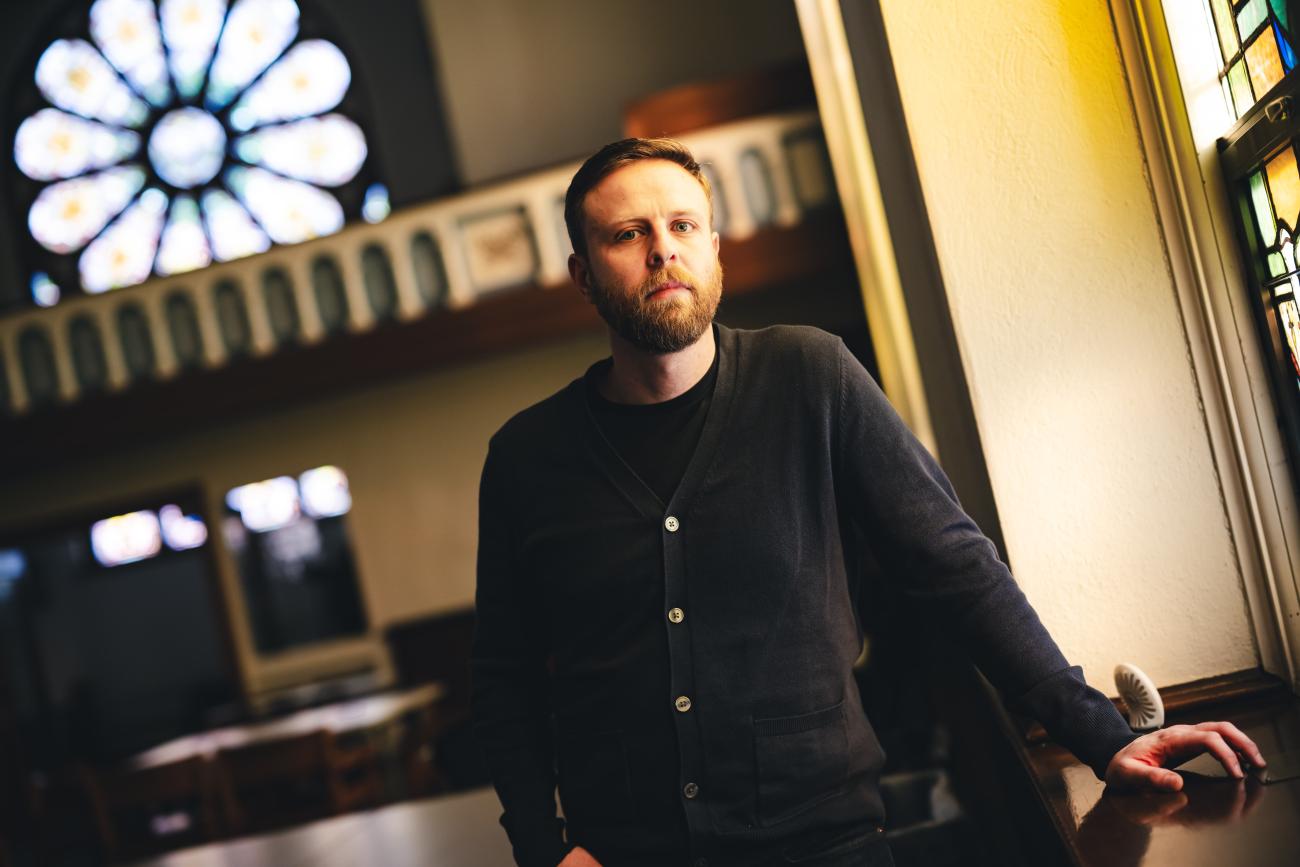
The Necro-President: How Death Became the Defining Metaphor of American Politics
Political theorist Dean Caivano MA’13 argues the 2024 election revealed not just partisan divides but the collapse of institutional vitality itself
When Florida Gov. Ron DeSantis took the stage at the 2024 Republican National Convention and compared President Joe Biden to the corpse from "Weekend at Bernie's," the crowd erupted in laughter. But for Dean Caivano, the joke exposed something far more disturbing than Biden's age or cognitive decline — it revealed that death itself had infiltrated the symbolic center of American governance.
"Really he was touching upon something that lies at the very heart of all political systems, but particularly a republican regime like ours," says Caivano, assistant professor of political science. "And that is the question of what comes next."
In "The Necro-President: Trump, MAGA, and the Decline of the American Republic," Caivano introduces a provocative framework for understanding the 2024 presidential election. He posits the election was not a typical contest between candidates, but as a referendum on whether the American republic retains any vitality at all. His central concept — the "necro-president" — operates as both figure and condition, describing how mortality and decay have become embedded in the language, symbols, and psychology of contemporary American politics.
From Political Theater to Existential Crisis
DeSantis's comparison was designed to invoke laughter, to operate on an emotional rather than rational level. But Caivano argues the rhetoric pointed to something the crowd intuitively understood: "The sense of decay and rot that is associated with death or a corpse has actually infiltrated the highest office in the land."
This wasn't simply partisan mockery. According to Caivano, DeSantis was "speaking to this very real threat and this undercurrent, this psychological anxiety that we feel about maybe there won't be a tomorrow." The anxiety has empirical support: "We have data that supports the fact that this is the first time in a hundred years where people over 50 don't think the future will be as promising for their children as it was for them."
The necro-president functions through two interconnected dimensions: as a specific figure (Biden, portrayed as declining) and as a broader condition (the normalization of institutional death). Caivano points to two episodes that crystallize this dynamic.
"In late July, we have elected representatives taking to social media to demand proof of life from Biden," he explains. Representative Lauren Boebert's insistence that Biden provide "proof of life" by 5 p.m. became a viral moment. "This is distinct from demanding a death certificate or an autopsy report. What that really suggests is that we are now living in the type of culture and society where we need to demonstrate our very own existence. This is a very strange phenomenon."
The second episode occurred after Trump's return to the White House, when the administration replaced Biden's presidential portrait with a framed photograph of an autopen — the mechanical device used to replicate signatures. "We have the normalization of not being there. We have the normalization of the lack of vitality, the lack of presence, the lack of life," Caivano says.
The implications extend beyond Biden himself. "We are living in a society that is not only questioning our institutions — ‘does the Supreme Court work, does Congress work?' but we're asking questions about are we even alive? Have we reached the point of decay that we can't even demonstrate the future of the American republic?"
The devolution from demanding proof of citizenship, as with President Barack Obama's birth certificate, to demanding proof of life marks a fundamental shift. "That's an erosion of trust. It's an erosion of belief; it's an erosion of faith. It's an erosion of imagination."
The Presidency's Double Nature
Caivano situates the necro-president within a longer history of executive power. "From Washington to today, the president has long represented the symbol of American vitality and power, the American dream, American strength, but it's also represented this duality. The presidency has represented life, but the American presidency has always contained with it a dimension of death."
This death-wielding power is constitutionally encoded in the role of commander-in-chief. "It's the President who decides. It was Truman himself who wrestled with the moral dilemma of whether or not to drop the bomb. One singular figure is granted such enormous authority to determine who lives and who dies."
The crisis emerges when this symbolic center loses coherence. "What happens when that singular figure, that symbol has lost its efficacy and has lost its relatability as a source of life or as an adjudicator of death, and in fact has become so hollowed out that it's devoid of meaning?"
The consequences ripple outward. "What happens to the American citizen when they can no longer look at these symbols and feel something? It severs our ties of connection. It severs our ties of community. It deeply instills apathy. It produces extremism and forms of violence." The surge in political violence represents a reaction against this feeling that collapse is already happening, he says.
If Biden embodied institutional death, Trump positioned himself as resurrection. He represents the defeat of a dead presidency and the enabling of a restored America. The July 13, 2024 assassination attempt became central to this narrative transformation. Caivano identifies "a subset of MAGA believers that see Trump in a theological light. They see him as a messianic figure, someone who will redeem the virtues and the values of the true original American republic."
This isn't simply political rhetoric—it's characteristic of authoritarian movements, Caivano notes. "Authoritarian regimes and fascist regimes exploit that religious currency. It is an essential ingredient of framing a singular figure as an embodiment of the populace, an embodiment of a fixer, of someone who can bring about greatness, prosperity, hope, peace for the homeland."
The evidence appears throughout MAGA culture: "Videos claiming that God has anointed him. Leading acolytes saying that Trump has survived assassination attempts because he's been shielded by God. Cultural artistic depictions of Trump sitting next to Jesus Christ in the courtroom. There is a very strong strain that has merged the presidency with a messianic Christian white nationalist figure. And without Trump, the future looks apocalyptic for those believers."
The messianic framing creates an irreconcilable theological paradox. "It poses a greater challenge to Christian theology, especially for those of the evangelical persuasion," Caivano argues. "For devout evangelicals, the second coming of Christ will only come at a time of most critical need, when governments have fallen. But Trump promises an eternal republic—a republic that can withstand the test of time and decay."
This creates an impossible bind: "What he's actually suggesting is the suspension of that eschatological dimension, meaning if the republic doesn't perish, Christ won't return. So Trump supporters are caught placing all their faith into this singular mortal man in order to save the present moment. But in doing so, it may foreclose the possibility of a Christian kingdom coming into the future."
Challenging American Exceptionalism
Caivano grounds his analysis in the classical republican tradition, which has always recognized that political systems inevitably decay. "We often argue about American exceptionalism, but I treat it in the sense that there's this deeply felt hubris — that we almost cannot imagine the collapse of the American republic."
That inability to imagine collapse is now fracturing. "Machiavelli said that all states begin to die as soon as they are born. The history of republics is one of rising and falling. We're coming up on a quarter of a millennium as an American republic. We would be wise to start talking about the reality of a decaying and eroding republic."
This reckoning extends beyond politics. "We need to act urgently because there is no guarantee that the American republic holds, but if we act with urgency, maybe we have a chance."
As an educator, Caivano observes institutional decay's effects on students. "There is a great sense of despair amongst our students. I don't think our students hold much confidence that the institutions of the present will ensure a free, just, promising future."
Yet he finds hope in their response. "Our students have a sense of imagination. They're already starting to think about what life will look like 10, 20 years from now, how it has to look different for resources to be allocated fairly, for access to clean water, nutritious food, decent paying jobs, healthcare and education. The system that we have, I don't feel hopeful about, but I do feel hopeful about the possibility of people wanting to change it."
As the United States approaches its 250th anniversary, Caivano sees the moment as potentially clarifying rather than celebratory. His analysis suggests 2024 marked a symbolic acknowledgment that the mechanisms designed to delay republican decay may have been exhausted under a tribal two-party form of government.
"We need to begin to entertain the idea of what a different political configuration might look like, because I don't see the coming together of these tribes under the Madisonian system as it currently is configured."
The necro-president is not an aberration but a symptom—the visible manifestation of institutional hollowing underway for decades, Caivano says. Biden's frailty became a screen for collective anxieties about republican mortality, while Trump's messianic framing offered the fantasy of transcending decay through authoritarian permanence. Neither resolves the crisis, he adds, but both confirm it.